

The Hub turns a Solidres site into a booking site for many properties run by many owners. Guests search every property at once, filter the results and book. Each owner, called a partner, signs in on the front end and manages only their own properties, room types and bookings from a partner dashboard, without ever opening Joomla's administrator. This article goes through what to set up after installing the Hub, in the order to do it.
PREREQUISITES:
- Solidres 4.7.0 or later, for Hub 2.5.0
- The Custom Field plugin (Solidres - Custom Field, 2.0.0 or later), installed and enabled before the Hub. The Hub's installer stops if it is missing.
- A Joomla Super User account
Step 1. Install the Hub package
Download the Hub package (Solidres_Hub_Installer_v2.4.1.zip) from your solidres.com account and install it in System → Install → Extensions. One package installs everything the Hub needs:
- Solidres - Hub plugin, the Hub itself, and Task - Solidres Hub, which expires partner subscriptions. Both are enabled for you.
- Two payment plugins for partner subscriptions, PayPal and Mobilpay, left disabled until you sell subscriptions.
- Eight site modules for search and browsing, described in Step 6.
Joomla updates the whole package from System → Update once your Download ID is in Solidres Options. To remove the Hub, uninstall the package, not its parts: Joomla does not let you uninstall one member on its own.
Step 2. Choose the partner user group
Solidres knows a partner by their Joomla user group. Create a group for them first, in Users → Groups → New, for example Partner with Registered as its parent. Then open Solidres → Options → Hub and select it in Partner user group. You can select more than one group.
Keep partners apart from guests: the partner group must not be one of the Customer user groups on the General tab, which a guest's account joins when they register or book.
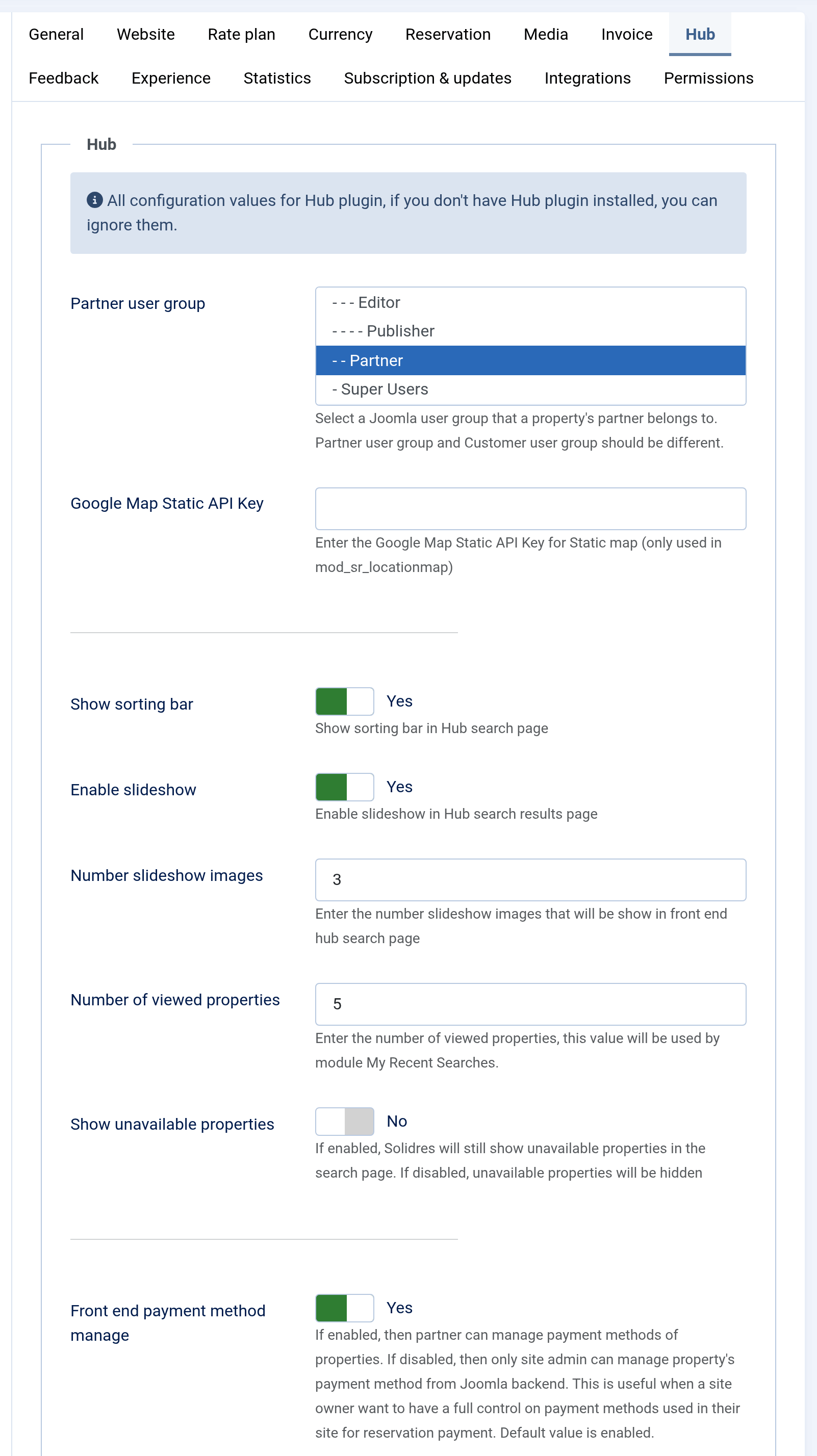
The rest of the Hub tab can wait until the site works. Step 7 lists the settings most sites change.
Step 3. Give the partner group its permissions
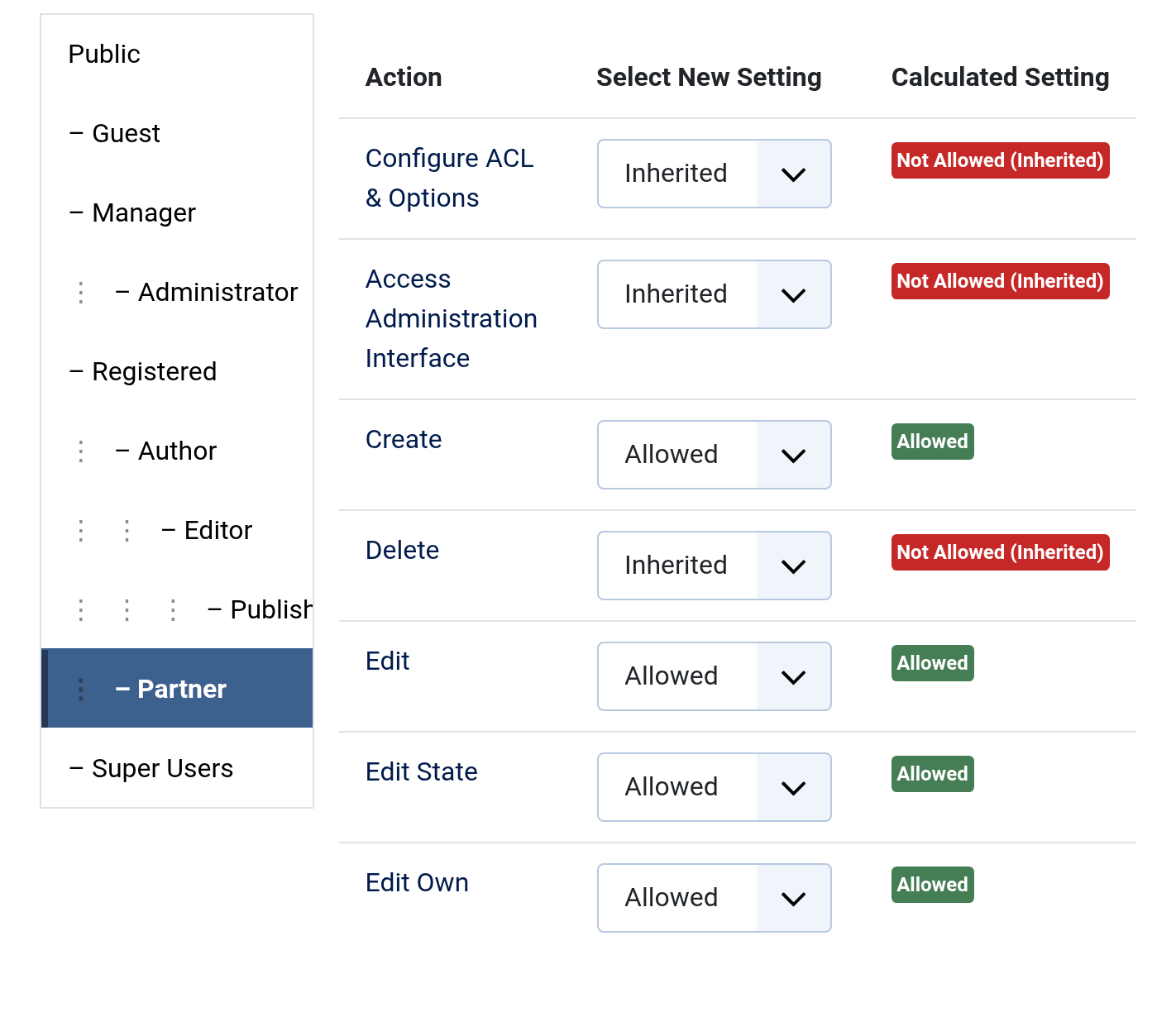
On the Permissions tab of Solidres Options, click the partner group and set these four actions to Allowed:
- Create, to add properties, room types, coupons and extras
- Edit, to open them again. Without it a partner sees Edit not permitted on their own property.
- Edit State, to publish and unpublish
- Edit Own
Leave the others, such as Configure ACL & Options and Access Administration Interface, as they are. Allowing Edit does not open other partners' properties: the partner dashboard only ever lists and opens the properties a partner owns.
Step 4. Make a user a partner
A partner is a Joomla user in the partner group. There are two ways to get one:
- Yourself: in Users → Manage, create the user or open an existing one, and tick the partner group on the Assigned User Groups tab. Saving the user also creates their Solidres customer account, which is what a property is linked to.
- By subscription: with subscriptions turned on, owners pick a plan on the front end, and signing up creates their account in the partner group. See How to configure subscription and commission.
To hand an existing property to a partner, open it in Solidres → Properties and choose the partner in Partner (owner), on the right of the Details tab. A property a partner adds on the front end is theirs already.
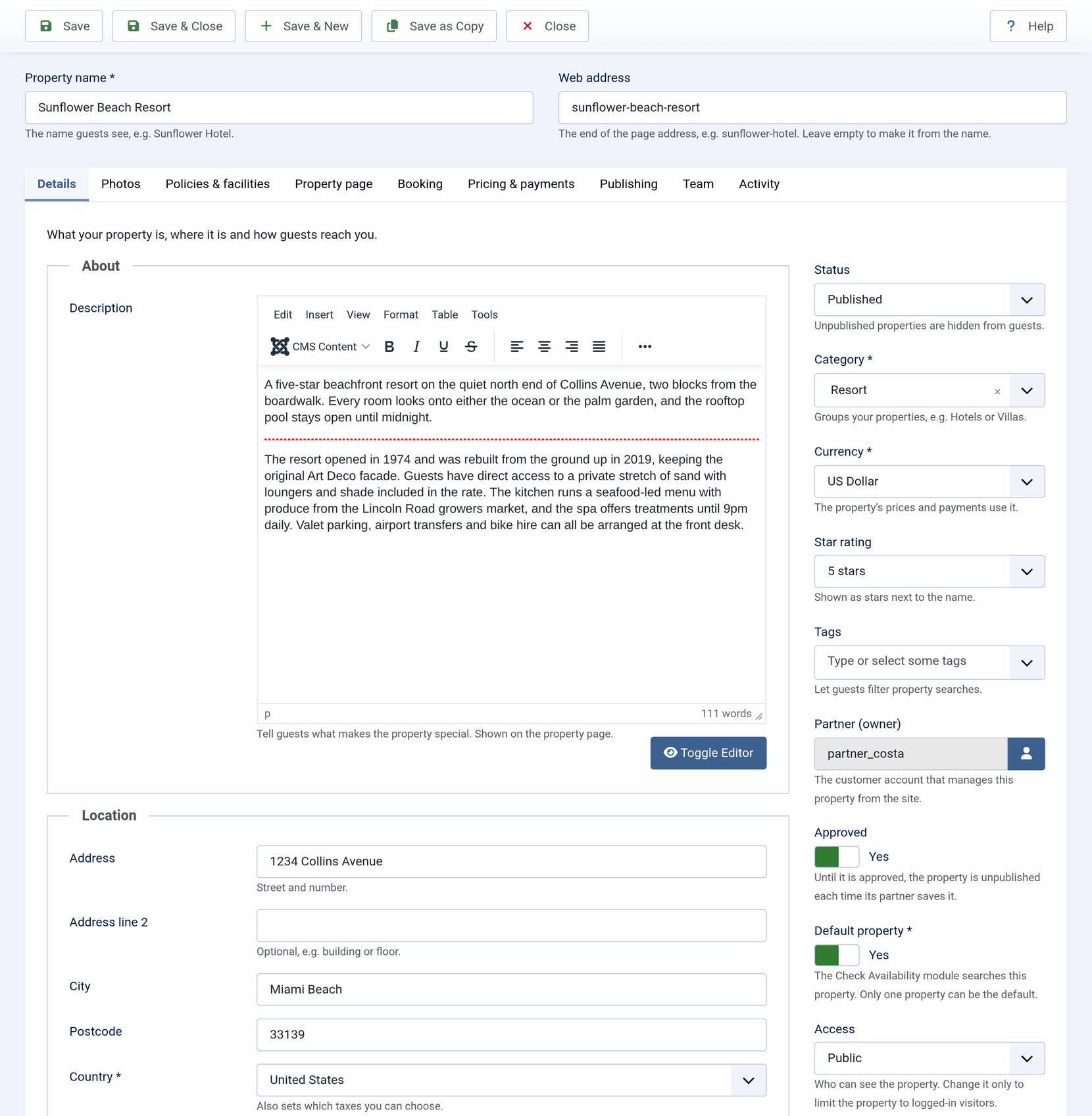
With Property submission approval on in the Hub options, the Approved switch appears below the partner. Until you approve a property, it is unpublished each time its partner saves it. The other settings partners don't see on their screen are listed in Setting up a property → For Hub partners.
Step 5. Create the menu items
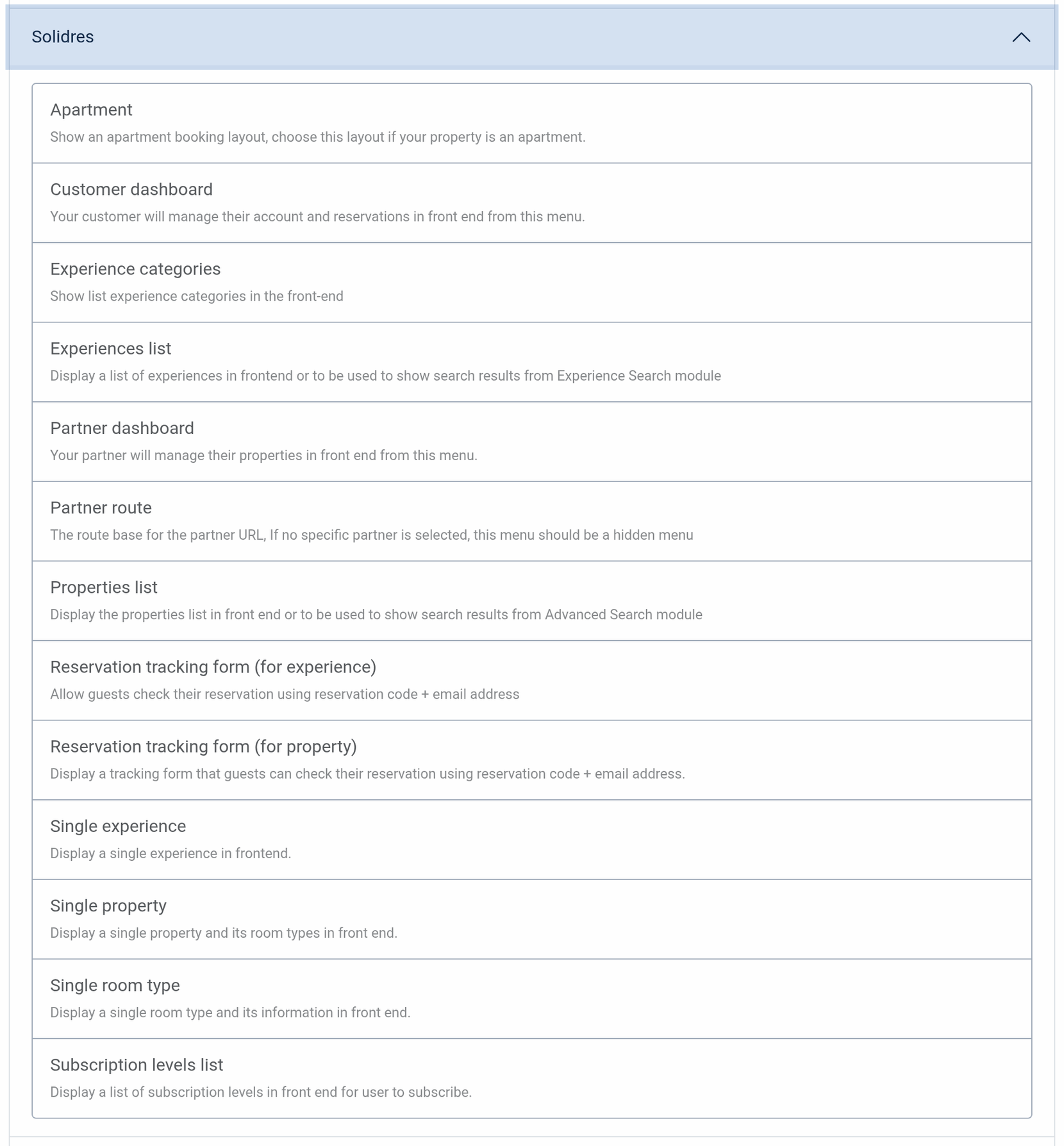
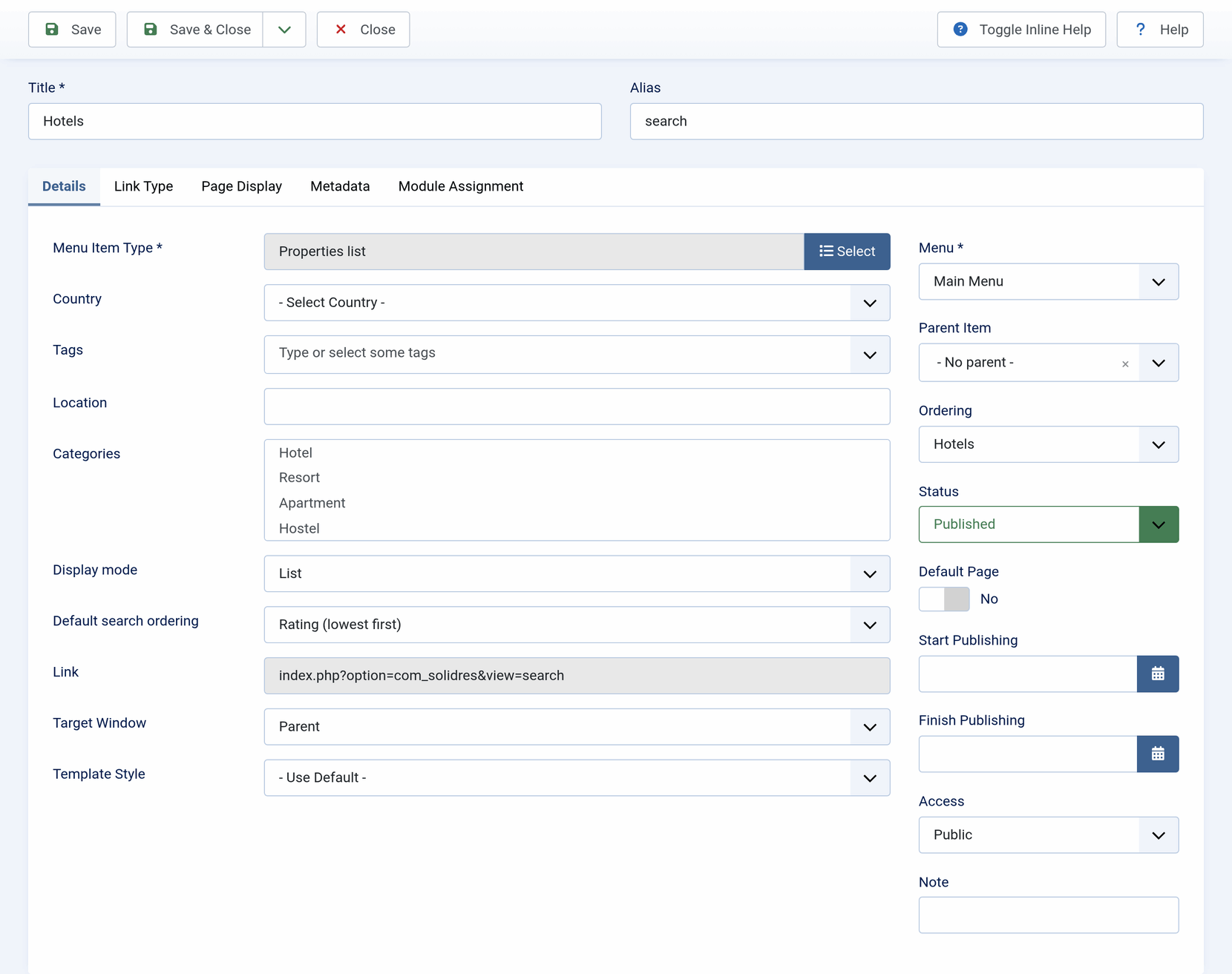
In Menus → Main Menu → New, click Select next to Menu Item Type and open the Solidres group. The Hub adds four types:
- Properties list: the search results page. The Advanced Search module sends guests here, and the Filter and Location Map modules work on it.
- Partner dashboard: where partners manage their properties. Put it where partners will find it, such as a user menu shown only to the partner group.
- Partner route: the base of each partner's public page, listing their properties and reviews. Choose a partner to make a page for that one partner; leave it empty and put the item in a hidden menu, so that every partner's page gets an address.
- Subscription levels list: the plans owners sign up to, when you sell subscriptions.
A Properties list item can show every property or only some: pick a Country, Tags, a Location (a city) or Categories to narrow it, for example a Lisbon item for one city. Display mode chooses a list or a grid, and Default search ordering how the results are sorted until the guest chooses.
Step 6. Publish the modules
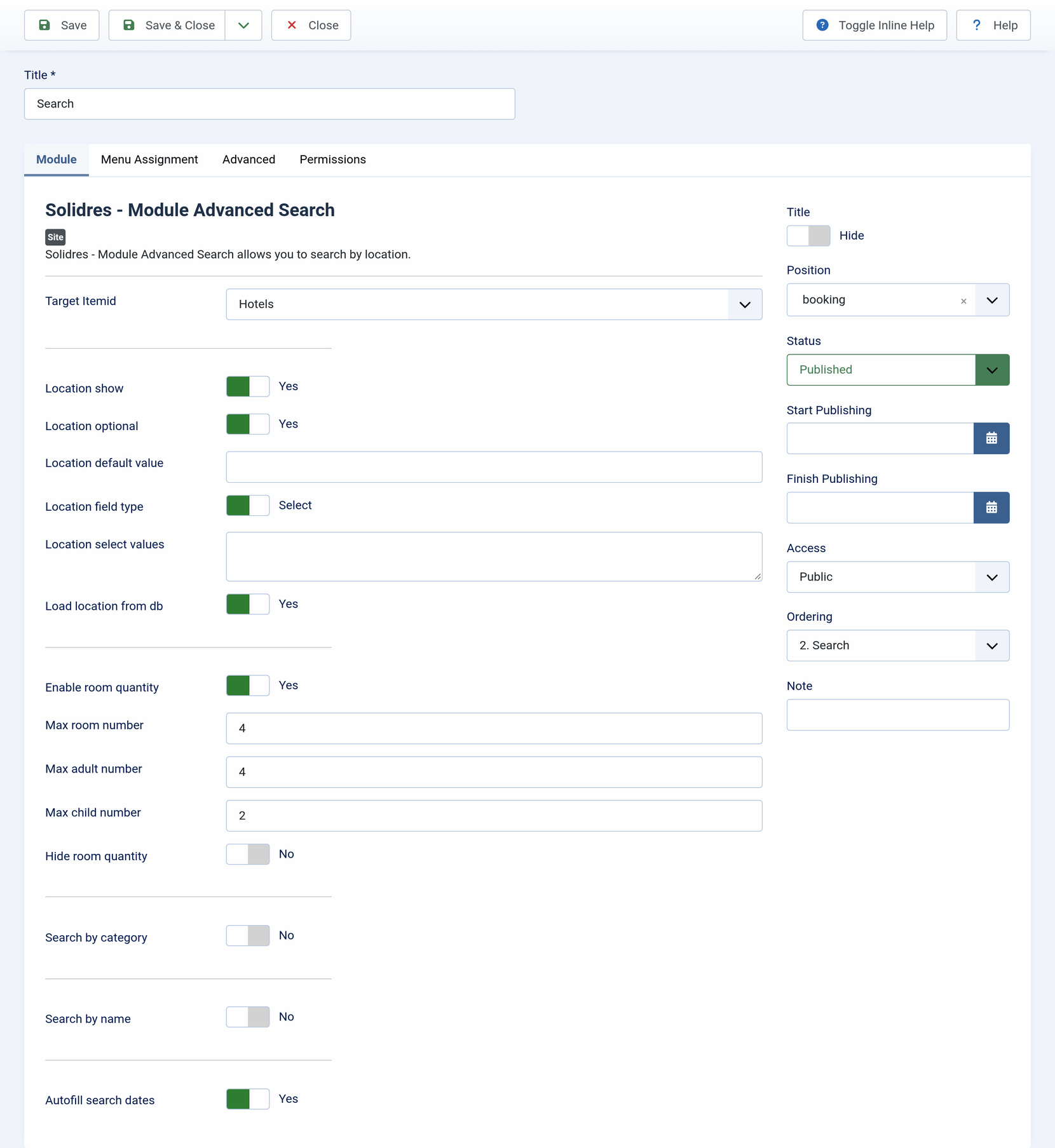
The package installs eight site modules but places none of them. Add each one you want in Content → Site Modules → New, choose a position from your template, and assign it to the pages it belongs on:
| Module | What it does |
|---|---|
| Advanced Search | The search form: location, dates, rooms and guests, and optionally category and property name. Set Target Itemid to your Properties list menu item, or the search has nowhere to send its results. |
| Filter | Narrows the search results by price, rating, category, facilities, themes, reviews, distance and tags. Place it beside the results, on the Properties list page. |
| Location Map | A map of the properties in the results. Its static map needs the Google Map Static API Key in the Hub options. |
| Assets | A showcase of properties, as a list, a grid or a carousel, often for featured stays on the home page. |
| Locations | Links to the destinations you choose, each opening the search results for that place. |
| Property types | Links to your property categories (hotels, apartments, villas…), with how many properties each holds. Set its Target Itemid like Advanced Search's. |
| My Recent Search | The properties the guest has looked at during their visit. |
| Surroundings | Other properties near the one the guest is looking at, on the property page. |
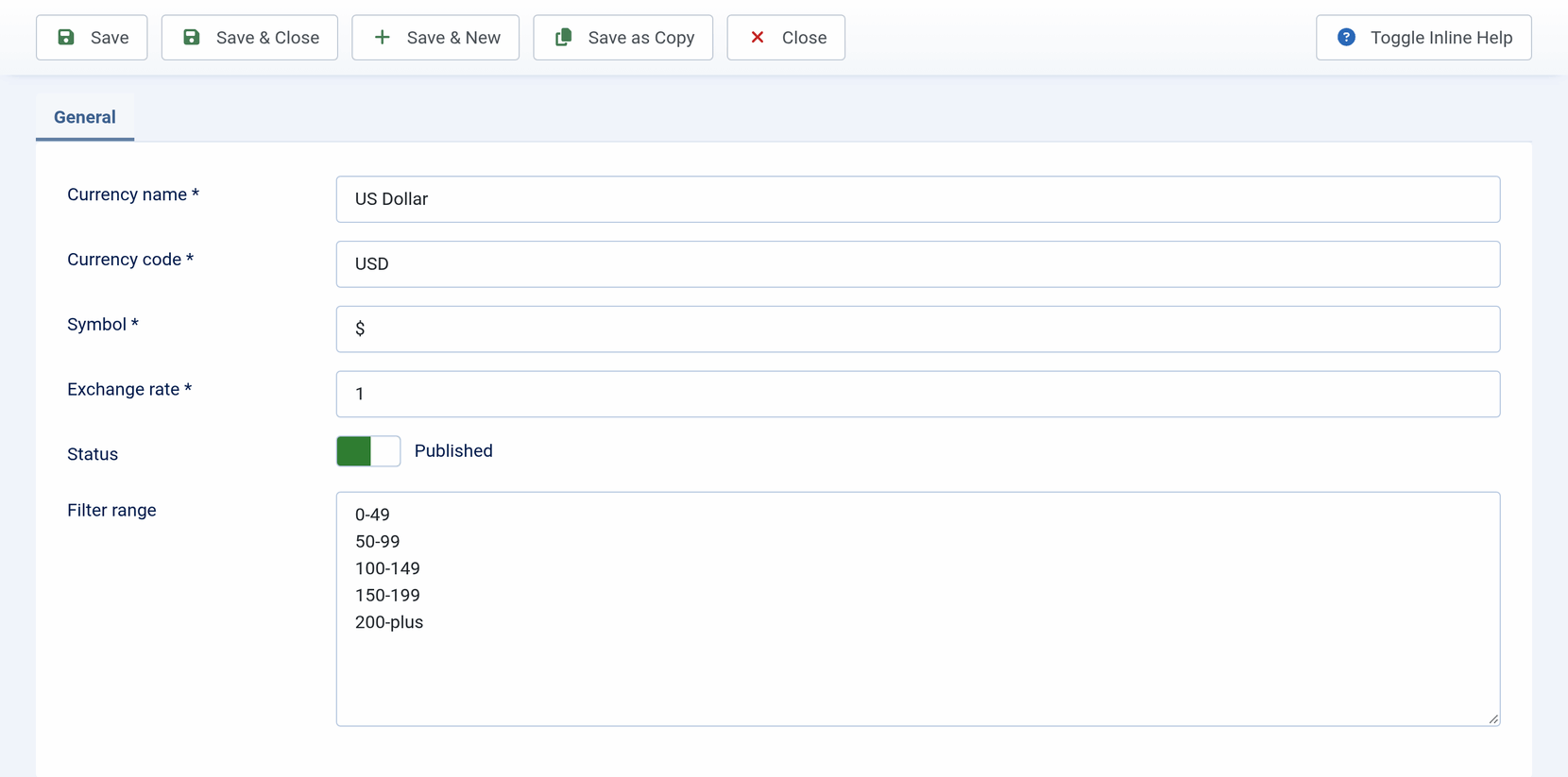
The Filter module's price filter reads its price bands from each currency. Open Solidres → System Info → Currencies, edit a currency and enter its bands in Filter range, one per line, the last one ending in plus:
0-49
50-99
100-149
150-199
200-plus
Give each currency bands that suit its amounts, such as 0-9999 for yen. A currency with no bands shows no price filter.
Step 7. Review the Hub options
Most of the Hub tab of Solidres Options can keep its defaults. These are the settings sites change most:
- Front end payment method manage: on, partners set up the payment methods of their own properties; off, only you do, in the administrator.
- The Show … filter switches: which filters the Filter module offers. Show static price filter filters by the price bands without dates; the guest number and bedroom filters are off by default.
- Show unavailable properties: whether a search lists properties that have nothing free on the guest's dates.
- Partner logout redirect: the page partners land on when they sign out of the dashboard.
- Enable subscription and Enable commission: the two ways to earn from your partners, below.
- Property submission approval: properties wait for your approval, as in Step 4. Notify email receives a message when a partner submits one.
- Ignored property fields and Ignored room type fields: settings to keep off the partners' screens, named by tab and section. A partner's save keeps their values, and only you can change them.
Step 8 (optional). Fine-tune what partners can manage
By default every partner can use every part of the partner dashboard. To choose which parts each group gets, install and enable the Solidres - ACL plugin, then open Solidres → System Info → Access controls. Click the partner group and allow what they may manage: properties, room types, reservations, coupons and extras, experiences, booking limits, feedback, invoices and reports. Once the plugin is on, a part that is not allowed disappears from the partner's dashboard, so allow at least Manage property.
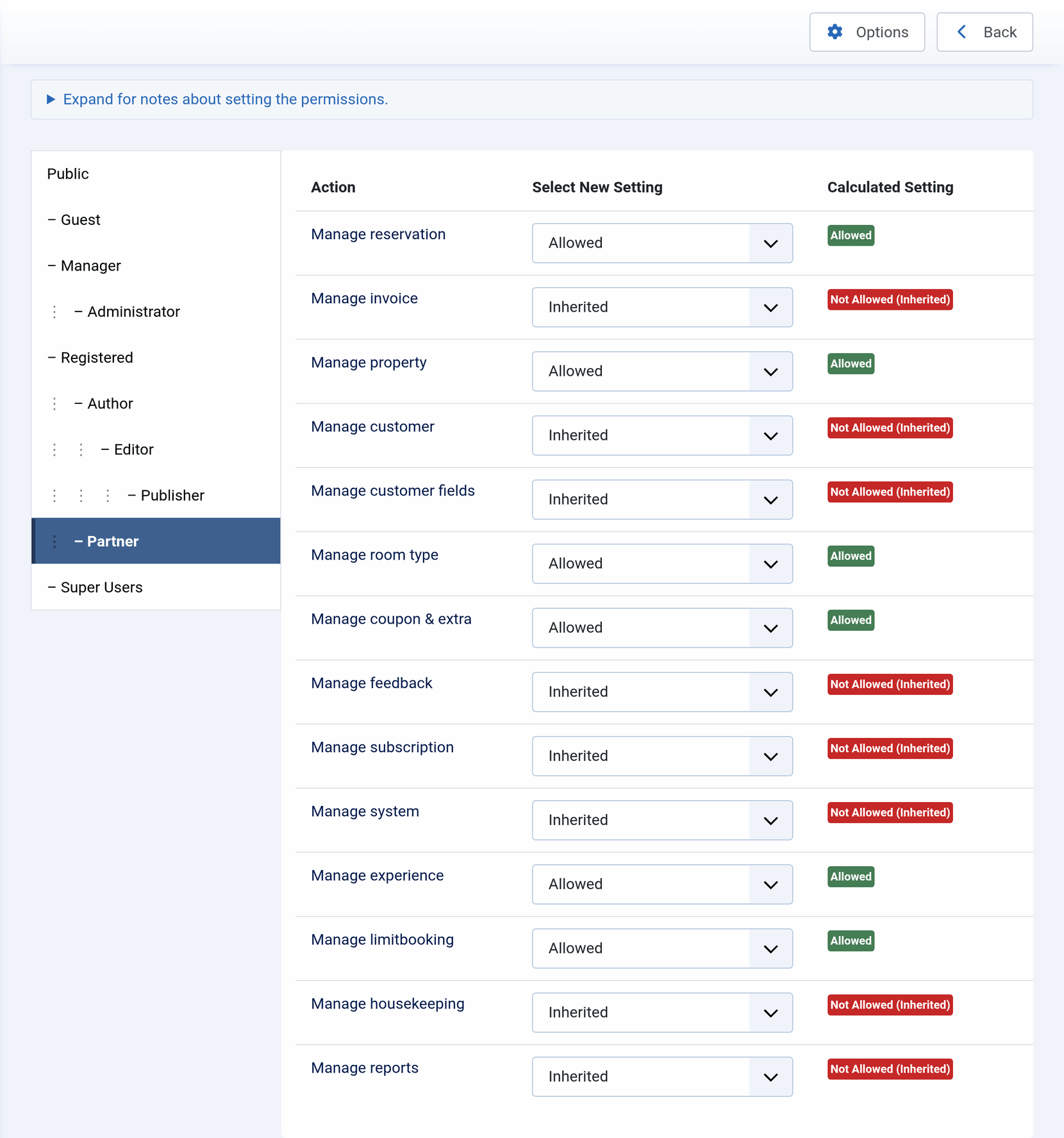
The same screen decides which parts of the administrator's Solidres menu each administrator group sees.
The partner dashboard
When a partner signs in and opens the Partner dashboard menu item, they see their own business only. Its menu leads to their properties, room types, reservations, coupons, extras, tourist taxes, booking limits and, with the Experience add-on, their tours. With the Dashboard add-on the page shows today's arrivals, departures and latest bookings, the month's performance and a revenue chart; with Front Desk the Properties menu links to its calendar.
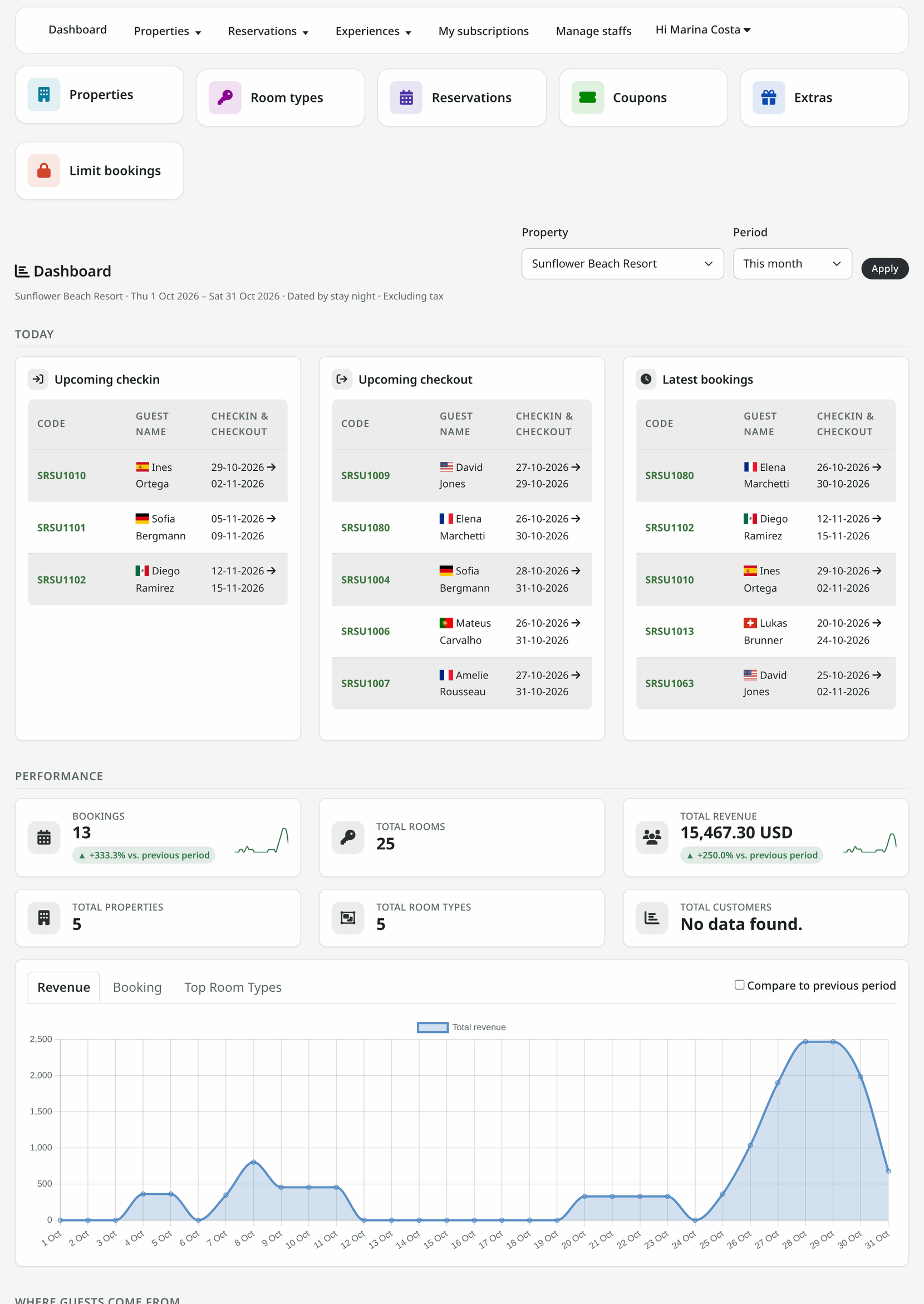
A partner's lists and screens follow the administrator's. Their property screen has the same tabs and sections as yours, without the settings only you set, as described in Setting up a property.
Their reservations list and reservation screen are yours too, limited to their own properties: the quick filters, the summary and the figures changed in place. On a booking they also see the sections add-ons add, such as the tours booked with the stay, and the files attached to notes, which they can download. The Commissions and Stream tabs and the link to the customer's profile stay yours. See Managing reservations.
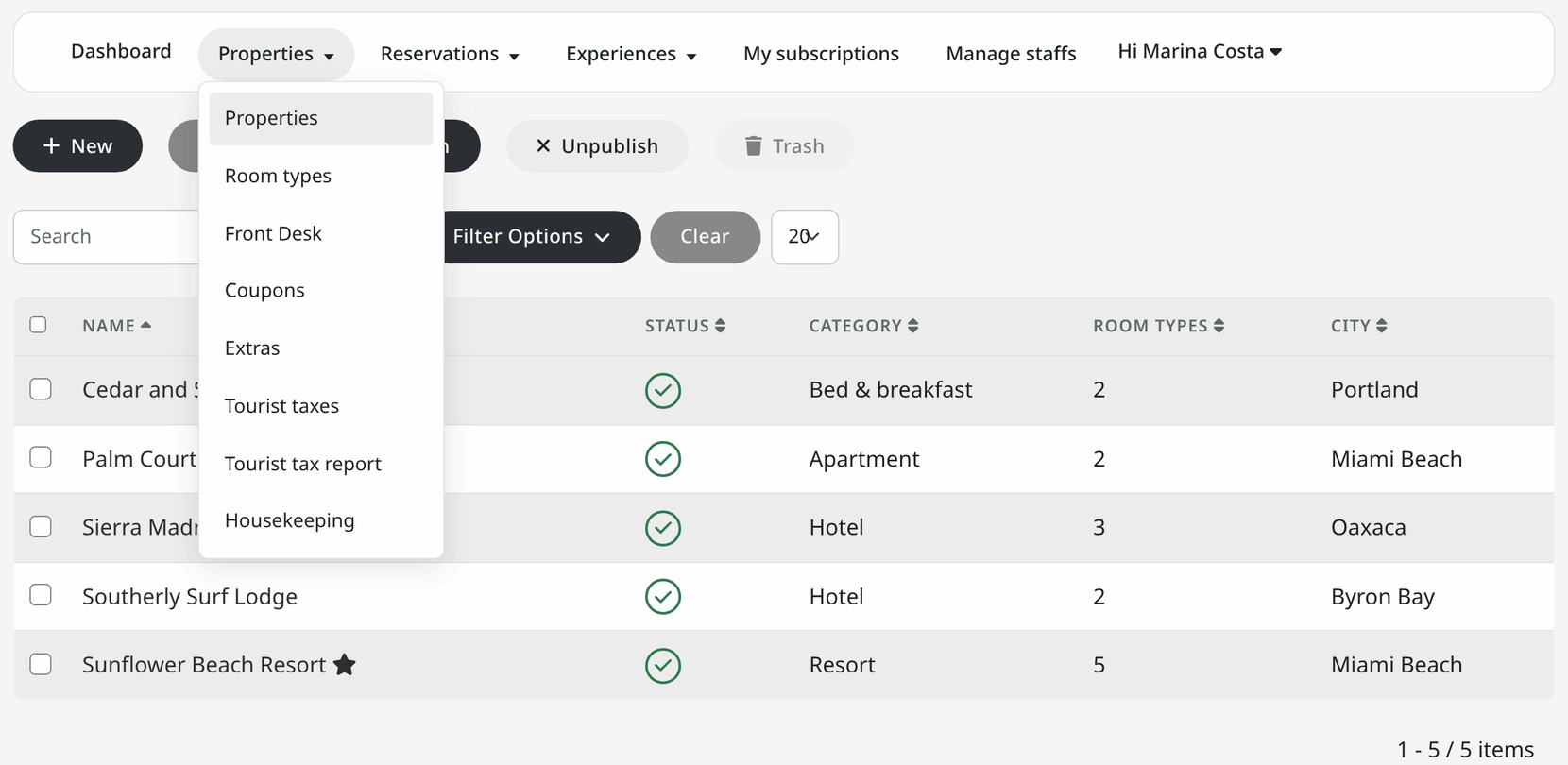
Partners can also add the people who help run a property as staff in Manage staffs. Staff sign in to the same dashboard and work on that property without being its owner.
Earn from your Hub: subscription and commission
Two optional features let you charge partners. With subscription, partners pay for a plan that sets how many properties they may list and for how long. With commission, you take a share of each booking. Turn them on in the Hub options and follow How to configure subscription and commission.
NOTE Selling subscriptions needs a payment plugin: enable Solidres - PayPal payment plugin for Hub subscription (or the Mobilpay one) in System → Plugins and enter its account details there. For PayPal, also add a webhook to your app in the PayPal Developer Dashboard and copy its ID into Webhook ID: since Hub 2.5.0, PayPal's notices about a subscription, refunds included, are ignored without it. Subscriptions also expire through Task - Solidres Hub, so make sure Joomla's scheduled tasks run: see How to set up Joomla cron for the Task Scheduler.